Work on Augmented reality

Last week we learned about augmented reality. In the upcoming weeks we will be making a music video and will also create a tour poster. The poster will have an element of augmented reality in it. So in preparation we did some work on augmented reality. We listened to a presentation on the topic. Once it was finished we were then placed into groups and were asked to do some research into augmented reality. We each looked up various different augmented reality campaign adverts on YouTube, looking at what was successful about the campaigns and what the limitations were.


I looked at several campaigns for Augmented reality. One that really inspired me a lot was the BBC Frozen Planet Augmented Reality – created by INDE. This campaign is particularly successful because of what it promotes. It’s in a museum with an environment that’s made to look and feel like Antarctica. The virtual reality makes it look like you can really see polar bears, whales and penguins which will make people very excited to go to it. This particular form of augmented reality got me very excited and I even wanted to experience it for myself. I saw families (featured in the video) that were behaving as if they could see animals right in front of them even though they weren’t really there. They were animals on a screen in front of them, and the experience was very 3D like and it made it look as if the animals really were in front of them (literally and not just figuratively). I imagine it must be a very exciting experience no one would want to miss.


This attraction features several engaging experiences including the augmented reality. It also has very interactive displays, soundscapes, interactive ice walls and feature displays. This experience delivers a vision of polar bears, landscapes, sea life and wildlife all through the use of technology. There is also the Streetmuseum app which is very successful because it is educating children about different animals and their habitats (in a very fun, fascinating, exciting and engaging way). It also gives people the chance to interact with technology in a way that they wouldn’t see every day.


I don’t believe it has any limitations (aside from you not being able to touch the animals but that’s to be expected) or disadvantages. It is completely perfect! If you wish to try the experience out for yourself, you will definitely get your money’s worth if it’s as good as I think it is. This shows how great of an experience augmented reality is and how it’s such a big step in the right direction. It’s a big step for mankind and makes me wonder if they will be able to take this technology further in the future.


You can watch the video of the campaign below, which I would definitely recommend.


Unit 6: film with no dialogue

On Wednesday, we started working on the film with no dialogue. I managed to get two of the students to volunteer for taking part in the acting of my film. We managed to get all the shots recorded in about half an hour and both actors did a fantastic job at it.

Unfortunately when I started editing the film in the afternoon, I found out with display I had lot several shots of footage. Today I came to the conclusion we had no choice but to but to reshoot those scenes. I came to the conclusion that we would have to reshoot every scene (even the ones we already had) for continuity purposes. Both students were happy to do a retake.

I have started editing it and so far the edit is going very well. I have hope it will look pretty good by the time it’s finished. I’ve found a very fitting piece of music for it that simply fits the tone of the sketch perfectly. I also hope to include some kind of sound effect at the end. God willing I will finish off the edit this afternoon.


Film with no dialogue

Yesterday we were told we had to create a short film with little to no dialogue. We watched a short silent film and were then told to start thinking about planning our own. I was struggling to decide for a while but eventually I came up with an idea. I have decided that God willing I will make a short film about a door and the main character keeps trying to open the door but is unable to

Promotional Video Proposal

Here is the proposal for my promotional video on the autism conference. I’ve filled in all that is so far applicable.

Objective: (what is the purpose of the video, what does it have to do and why?)
The purpose of the video is to make everyone aware of the North Wales annual autism conference, which is a very important conference because it has the goal of raising awareness and acceptance of autism.
Description: (What format will it take, what will it look like? Does it need to be made a certain way, or have a specific look, or house brand style?)
It will God willing take the form of showing the footage of people being interviewed (the best bits) and show footage of the conference being included in it.
Key Messages: (What does it need to say? What do you need to include for it to meet the requirements of the client?)
It needs to let people know about the conference, why it’s so important and to motivate people to attend it.
Pre-Production (Use the template sheets on the Google Classroom Welsh Bacc page)


Storyboard                                                                (tick boxes when completed) Wasn’t really needed for what we were doing
Risk Assessments (for all locations) Yes
Location Recces (each location needs checks: safety / power / access, etc) No
Equipment booked (ensure you have everything you need) Yes
Release Forms (cast and talent) Yes
Call sheets (for talent and crew to attend filming dates / times) Yes
Production Schedule (dates and times when production happens) Yes


Production


Undertaken planned tasks within timescale Yes
Backing up data after creation (create additional backups for safety) Yes
Logging data to keep records of what has been shot Yes

Report on interviews


Earlier in November, I  worked on interviewing a fellow student (Nieve) and this interview was recorded with two cameras and a sound recorder. We also had a clapper board to keep sound footage and both pieces of camera footage all in sync. One camera was further away using a wide angle shot and the other one was closer up. We used soft lighting which is common for interviews, as it is flattering and pleasant to look at.


At first, I found them all really difficult to line up and really struggled to get it all to fit in a way that worked. I kept finding the sound footage didn’t quite fit with the video footage. Eventually I was given some extra time to work on it and at this point: I managed to figure it out. I was informed that I had to find where the clapper board in each piece of footage went on. If you looked at all the footage pieces closely on the timeline: you’d see a certain spike where the clapperboard happened. I learned I had to line all the spikes up and chop all that happened before the clapper board out of the film. I realised that this method makes editing footage with different layers so much easier and they all line up absolutely perfectly with no delay.


Learning to sync different footage layers has always been something I’ve wanted to be able to do and my desire to learn this was one of the main reasons I enrolled on the course in the first place. And it feels like a great accomplishment that I now know how to do that. I’ve only been on the course for two months and I’ve already learned some very useful and important skills that I can use. I decided to portray the footage in a way that when I ask the questions, I would use the wide angle footage, and when it was focussed on Nieve answering the questions I would use the more close up camera footage so I would be using a back and forth pattern method for the editing of this interview.


I also tried to add a few effects to the film. I tried to edit the colouring to give it a unique effect but unfortunately this backfired on me. I found it so hard to control particularly when trying to get both pieces of footage to have the same colouring throughout. I edited the imagery of one of the clips, but the one next to it looked all dark and weird and this was really hard to get right. In fact, learning to get that right is still a skill I haven’t yet learned and hope I can develop. I hope that in time I will learn how to do it properly.


I also introduced the interview with a logo using the image of a clapperboard and the title Film Talk (because the topic of the interview was films) appeared on screen. Looking at it now, I think the introduction may have gone on for a bit long. It went on for nearly seven seconds and I imagine some people with a short attention span might go off it if they were watching. There are a few other ways in which I could have improved the interview. It would have been better to practice the interview before doing it so I could have all my questions completely rehearsed, and Nieve could have her answers rehearsed and I could know which questions would be too difficult for her to answer.


My next tip for improvement couldn’t be helped at the time, but it also would have been good to have a camera angle focussing on the person asking the questions as well. As it is, there are only two camera angles in the film. The wide angle shots show my hands and my question notepad but don’t share anything else which can be a bit awkward to look at because it keeps switching to someone’s notepad and hands but doesn’t show anything else of them! It’s especially awkward at the end when I start talking to the audience but all they can see is mostly my hands. If I ever do an interview again, I think I will try to avoid this. As well as this, I feel like I should also be more cautious about the kind of questions I ask since they can sometimes be too difficult. I also believe that maybe it could have benefited from some musical accompaniment, even if it was only at the beginning and the end. I would also like to learn to change the colouring on all of the clips without making a mess on some of them (like I did previously).

Interviews in the TV studio

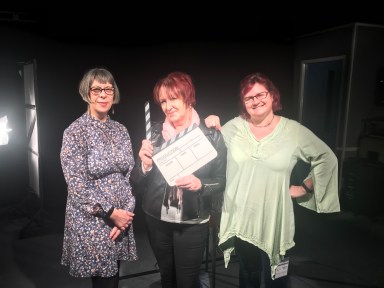
Yesterday I did further work on my promotional advert about the North Wales Annual Autism Conference. I interviewed three of the people who helped set up these conferences. We did it all in the TV studio with two very posh and professional cameras of different angles. We also had a clapper board to sync all the shots. It felt incredible like something I’ve always wanted to do.  I’m hoping this afternoon we will be able to edit it. I asked them about how the conference was set up and what made it a success. I hope that I can use some of the footage for the advert to make something good.          
9949E527-CE13-4A3B-AF4A-45705D6C6D51.jpeg